

TLDR - Quick Answer: Web hosting is the service that keeps your website live and accessible on the internet. For South African small businesses, the most important factor when choosing a hosting provider is not the cheapest price. It's the quality of support when something goes wrong. Servers physically based in South Africa improve your website's loading speed for local visitors. If budget is a real concern, IVECloud offers WordPress and professional email hosting from R66 per month with genuinely hands-on support. And if you ever decide to switch providers, most reputable hosting companies offer free migration so do not let the decision hold you back from getting started.
Choosing the right web hosting in South Africa is one of those decisions most business owners make once, forget about, and only think about again when something breaks.
I once got a panic call from a client in the construction industry. His website had been down for three days. His hosting provider's support line rang out every time he called, and the professional email accounts his customers used to reach him had stopped working entirely. He had chosen his hosting plan because it was the cheapest option that came up in a Google search.
That story is not unusual. I have seen it repeat itself many times over nearly a decade of building and managing websites for South African service businesses.
This is not a generic ranking list of hosting providers. It is a practical, honest guide to choosing web hosting for your WordPress website and professional email - the two things that actually matter for most small business owners in South Africa.
What Is Web Hosting?
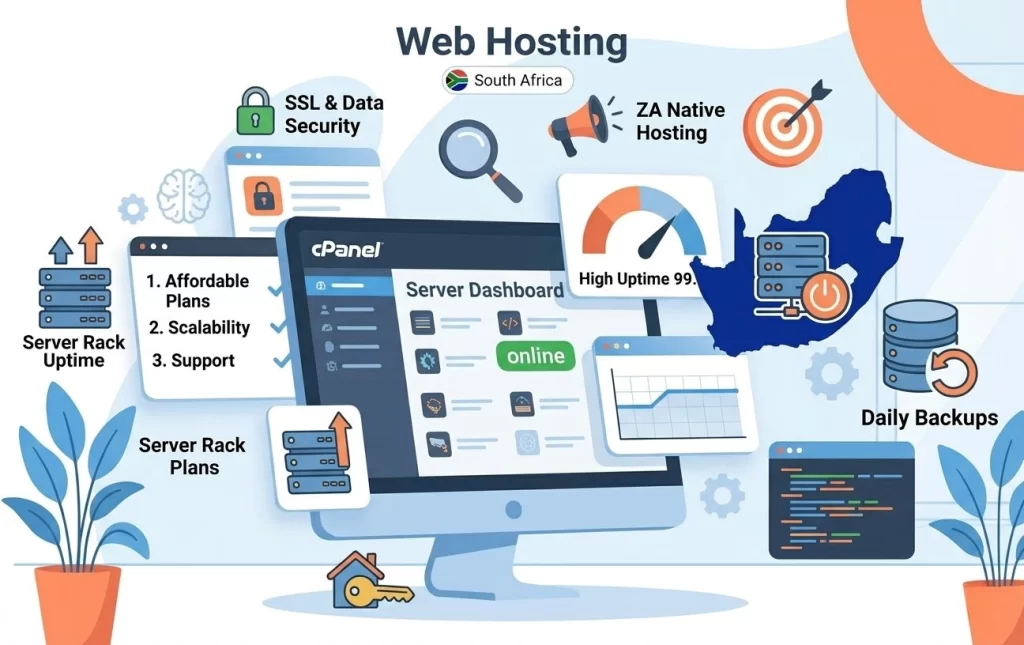
Web hosting is the service that stores your website files on a powerful computer, called a server, that stays on 24 hours a day, 7 days a week. When someone types your domain name into their browser, those files are delivered from that server to their screen.
For most South African service businesses, two things live on that server:
- Your WordPress website: the pages, images, and content that visitors see
- Your professional email accounts: your name@yourbusiness.co.za addresses
These two are often bundled together in a single hosting plan. That is why getting this decision right matters more than most people think because your website and your email are both sitting on the same foundation.
It is also worth understanding that your domain name, the web address itself, like yourbusiness.co.za is registered separately from your hosting. Most hosting providers will register it for you as part of the signup process, which is convenient, but it is a separate product. Keep track of where your domain is registered and when it renews. A lapsed domain is one of the easiest ways to lose your website and email access overnight and it happens more often than you would expect.
One more thing that catches people off guard: your hosting plan directly affects how your email behaves in the real world. A hosting environment that is poorly configured or on a blacklisted server will cause your outgoing emails to land in spam folders even if everything looks fine on your end. When a plumber sends a quote to a potential client and it sits unread in their junk folder, that is not a marketing problem. That is a hosting problem. Choosing a reputable provider with properly maintained infrastructure means your emails reach inboxes, and your professional reputation stays intact.
The Mistake Most Business Owners Make
The most common mistake I see is straightforward: choosing a hosting provider based on price alone.
I understand the logic. Running a small business means watching every rand. But web hosting is one of those areas where cutting costs too aggressively tends to cost you more in the long run - in time, frustration, and lost business.
Here is what cheap hosting often actually means in practice:
- Servers packed with too many websites, causing your site to load slowly
- No real support: automated responses, helpdesk tickets with 48-hour reply windows, or no response at all
- Unreliable uptime: your site going offline without warning, sometimes for days
- Email deliverability problems: your professional emails landing in customers' spam folders
When your website goes down on a Sunday evening before a Monday morning pitch, or a client cannot reach you because your email has stopped working, you do not want to discover that your hosting provider's idea of support is a knowledge base article.
What Actually Matters When Choosing a Hosting Provider
1. Support Quality - This Is the One That Matters Most
After 10 years of managing WordPress websites and hosting for South African businesses, the single factor that separates a good hosting experience from a terrible one is the quality of support.
Not price. Not the number of email accounts included. Not unlimited storage. Support.
When something goes wrong (and at some point, something will) you need a real person who knows what they are doing, who responds quickly, and who will stay with you until the problem is solved. Some hosting companies have teams like that. Others will copy-paste links to knowledge base articles until you give up and figure it out yourself.
The difference only becomes visible in a moment of crisis. That is exactly the wrong time to find out which kind of company you signed up with.
2. Servers Based in South Africa
Where your website files are stored matters. A website hosted on servers within South Africa will load faster for South African visitors than one hosted overseas in Europe or the United States.
This is not a minor difference. A slow-loading website frustrates visitors and increases the chance they leave before reading anything. Google also uses page speed as a ranking signal, a slow site can directly hurt your position in search results.
When comparing providers, look for hosting companies with physical servers based in South Africa.
3. WordPress Compatibility
The vast majority of business websites in South Africa run on WordPress. Your hosting plan needs to support it properly with the right server environment, easy installation, and ideally a support team that understands WordPress-specific problems.
Some providers charge extra for plans labelled "WordPress hosting." In most cases, this is a marketing distinction, standard shared hosting handles WordPress perfectly well for the majority of service business websites. Do not pay a premium for a label.
4. Professional Email Hosting
Your hosting plan should include professional email accounts. Most standard plans in South Africa include between 3 and 10 accounts which usually is more than enough for a small service business.
The important thing is that your email is configured correctly for deliverability. Sending quotes from a name@yourbusiness.co.za address that consistently lands in clients' spam folders is a real problem, and one that many business owners do not even know they have.
Understanding the Different Types of Hosting
When you start comparing plans, you will encounter several terms. Here is a plain-English breakdown:
| Hosting Type | What It Means | Who It Is For |
|---|---|---|
| Shared Hosting | Your website shares a server with many others | Most small businesses |
| VPS (Virtual Private Server) | You get a dedicated portion of a server | Higher traffic or technical requirements |
| WordPress Hosting | Shared hosting marketed for WordPress | Often just standard shared hosting with a new label |
| Cloud Hosting | Files spread across multiple servers | E-commerce, high-traffic sites, larger businesses |
For the vast majority of South African service businesses such as plumbers, electricians, cleaning companies, medical practices, the standard shared hosting is all you need. You do not need a VPS or a cloud server to run a professional business website.
What Nobody Tells You About Resellers
Here is something most hosting comparison articles will not mention: a significant number of web hosting companies in South Africa are resellers. They do not own or operate their own servers. They purchase hosting capacity from a larger provider and sell it to you under their own brand.
Reselling is completely normal and accepted in this industry. Many reputable companies operate this way, and it does not reflect badly on the quality of service you receive.
But there are bad actors worth knowing about.
Some resellers charge significantly inflated prices, billing you R300 to R500 per month for a hosting plan that would cost R60 to R100 if you went directly to the underlying provider. Always benchmark what you are paying against the open market.
More seriously, some resellers will make it deliberately difficult (or expensive) to leave. They charge exit fees, withhold your website files, or create friction during the migration process. This is not how the industry operates among reputable companies.
The standard practice is free migration, no penalty, no questions.
Before committing to any provider, ask them directly: "If I decide to move to a different host in future, is there any charge, and will you hand over all my files?" A trustworthy provider will answer that question without hesitation.
Which Provider Should You Choose?
Rather than giving you a padded list of 12 options to work through yourself, here is a direct recommendation.
If budget is a genuine concern: IVECloud is the provider I have been recommending to clients for the past five years. Starting from R66 per month, you get WordPress hosting, up to 5 professional email accounts, and servers physically based in South Africa. What sets them apart is their support; hands-on, personal, and the kind of team that will go the extra mile without being asked. In five years of recommending IVECloud to clients, I have not once had a client come back with a complaint about their service. They have been in business for decades, which matters when you are trusting someone with your online presence.
Other reputable options: Xneelo, HostAfrica, and Domains are all well-established providers with solid track records. Each has its own strengths. Research their current plans and read recent reviews before making a final decision.
Do Not Overthink the Decision
Here is the part that should give you some peace of mind: as long as you choose a reputable provider and avoid the red flags mentioned above, you cannot make a catastrophically wrong decision.
If you sign up with a hosting company, use their service for a year, and then decide you would prefer to be somewhere else, you can simply move. Most legitimate hosting companies offer free migration. Your website files, email accounts, and domain can all be transferred to a new provider without losing anything.
In practice, a migration typically works like this: you sign up with your new provider, let them know you are moving from your current host, and they handle the technical transfer. For a standard WordPress site with professional email, the process is usually completed within 24 to 48 hours. Your website stays live at the old host until the new one is confirmed working, so there is no downtime gap where visitors cannot find you. It is less dramatic than most business owners imagine.
There is also a practical distinction worth knowing: you do not always have to move your domain when you move your hosting. Your domain can stay registered at one company while your website and email are hosted at another. This flexibility means you are never truly locked in anywhere i.e. the assets/files are yours, and they are portable.
The goal is to get a reliable setup in place and move forward. Spending three weeks comparing feature tables while your business sits without a properly managed online presence is a cost in itself!
Your Website Needs More Than Just Hosting
Here is something worth thinking about. Most business owners treat their website like a printed brochure - designed once, handed over, and expected to generate business by sitting still.
But a printed brochure cannot show up in a Google search at 11pm when someone urgently needs a plumber. It cannot reply to an enquiry automatically, qualify a lead, or send you a report on what is and is not working every month.
A website should work more like a gym membership than a once-off purchase. You do not buy gym equipment, leave it in the garage, and expect to get fit. You pay a monthly fee for access to the facility, the ongoing environment, and the structure that produces real results. That is how a website should work for your business.
That is the thinking behind the Smart Website System from Align Designs.
For R699 per month with R0 upfront, you get a fully managed website system - not just a page sitting on a server. This includes:
- A professionally designed, mobile-responsive WordPress website
- Managed hosting with ongoing maintenance and updates
- An AI chatbot that engages visitors and captures leads automatically
- A semi-automated quote request flow so no enquiry goes unanswered
- A monthly performance report so you always know exactly what your website is doing for your business
After 24 months, you own the site outright. It works exactly like a cellphone contract - monthly payments for a premium managed service, and full ownership of the asset at the end of the term.
And if it is not the right fit within the first 20 business days, you can cancel with no questions asked and no penalty.
Frequently Asked Questions
What is the best web hosting in South Africa for small businesses?
The best web hosting for South African small businesses prioritises support quality and locally based servers over the lowest possible price. For budget-conscious businesses, IVECloud offers WordPress and professional email hosting from R66 per month, with servers based in South Africa and a support team known for hands-on, personal service. Businesses that want everything fully managed can explore the Smart Website System from Align Designs, which includes hosting as part of a complete monthly package.
How much does web hosting cost in South Africa?
Basic shared hosting in South Africa typically ranges from R60 to R200 per month, depending on the provider and features included. Most plans in this range include WordPress support and a set of professional email accounts. Choosing purely on price is rarely the right strategy - poor support quality and unreliable uptime can cost a business far more than the few rands saved each month.
Can I host my website and professional email on the same hosting plan?
Yes. Most shared hosting plans in South Africa include both website hosting and professional email hosting as part of the same package. Basic plans typically include between 3 and 10 email accounts, which is sufficient for most small service businesses. It is important to ensure your email is properly configured for deliverability so that outgoing messages reach inboxes rather than spam folders.
What happens if I want to switch to a different hosting provider?
Most reputable South African hosting companies offer free website migration - they will transfer your website files, databases, and email accounts to a new provider at no charge. Be cautious of any provider that charges exit fees or creates deliberate friction when you want to leave, as this is not standard practice among legitimate operators and is a sign worth taking seriously before you sign up.
Do I need WordPress-specific hosting, or will standard shared hosting work?
Standard shared hosting works perfectly well for WordPress websites in the vast majority of cases. "WordPress hosting" is often a marketing label applied to standard shared hosting plans with minor optimisations. Unless your website handles high traffic volumes, standard shared hosting is sufficient and you should not need to pay a premium for a plan labelled specifically as WordPress hosting.