

TLDR - Quick Answer: Shopify's base plans start at approximately R350–R460/month (Basic, billed annually), but the real monthly cost for a South African store is considerably higher once you factor in mandatory third-party payment gateway fees - since Shopify Payments is not available in SA, along with app subscriptions, a custom domain, and USD billing that moves with the rand. On R100,000 in monthly revenue, Shopify Basic can cost over R6,400/month in combined fees. WooCommerce, by comparison, has no monthly platform fee and comes in around R3,700/month at the same revenue level. Shopify is a legitimate ecommerce platform, but the advertised price and the actual running cost are two very different numbers.
If you've typed "Shopify pricing South Africa" into Google, the first thing you'll see is the official pricing page. Basic: $19/month. Grow: $49/month. Advanced: $299/month. Clean numbers. Easy to read.
What that page doesn't explain is that South African merchants face a specific set of costs that international Shopify users simply don't deal with. When you add those up, especially once you're doing any meaningful volume of sales, the platform becomes significantly more expensive than the headline pricing suggests.
This article breaks down what Shopify actually costs to run in South Africa, the charges most pricing guides leave out, and how it compares to WooCommerce so you can make a genuinely informed decision before you commit.
Shopify's Plans in Rands
Shopify offers three main plans for small-to-medium businesses.
Prices below are based on annual billing, converted at approximately R18.50 to the US dollar:
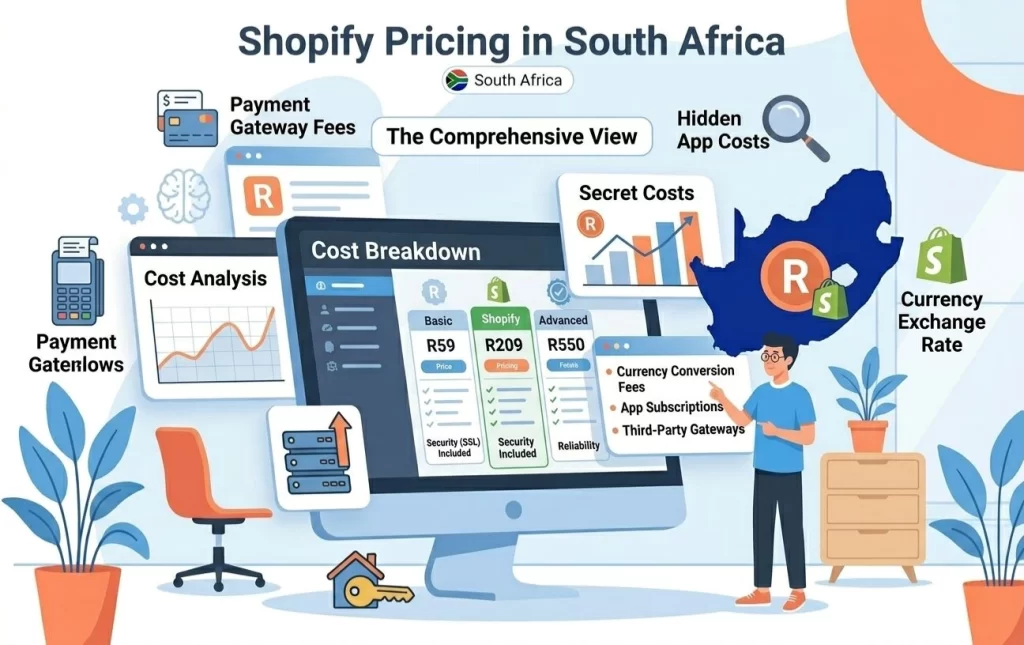
| Plan | USD/Month (Annual) | ZAR Approx. | 3rd-Party Transaction Fee |
|---|---|---|---|
| Basic | $19 | ~R350 | 2% |
| Grow | $49 | ~R905 | 1% |
| Advanced | $299 | ~R5,530 | 0.6% |
| Plus | $2,300 | ~R42,550 | Custom |
*Monthly billing without an annual commitment adds approximately 25–30% to each plan.
For most South African businesses just starting out, the Basic plan is the natural entry point. At face value, R350/month is accessible. But this is only the base rate and it's before the SA-specific costs kick in.
The Costs Shopify Doesn't Lead With
Shopify Payments Isn't Available in SA
Every Shopify plan advertises reduced transaction fees when you use Shopify Payments, their built-in payment processor. Here's the problem: Shopify Payments is not available in South Africa.
Every South African merchant must use a third-party payment gateway. PayFast, Yoco, and Peach Payments are the most common options. Each charges its own transaction fee and on top of that, Shopify charges you an additional fee per transaction because you're not using their native tool.
The combined cost looks like this:
| Plan | Shopify Fee | PayFast Fee (approx.) | Combined Per Transaction |
|---|---|---|---|
| Basic | 2% | ~3.5% + R2 | ~5.5% + R2 |
| Grow | 1% | ~3.5% + R2 | ~4.5% + R2 |
| Advanced | 0.6% | ~3.5% + R2 | ~4.1% + R2 |
On a R1,000 sale using the Basic plan, that's approximately R57 in fees. Scale that to R100,000 in monthly revenue and you're paying roughly R5,700 in transaction costs, before your subscription fee.
Your Costs Are Tied to the Exchange Rate
Shopify's platform fees, most premium themes, and the majority of paid apps are all billed in US dollars. The rand's volatility is not a theoretical risk, it's a practical one. When the rand weakens, your monthly cost goes up automatically, with no cap and no warning.
Budget with a 10–15% buffer above the current ZAR equivalent when projecting your monthly ecommerce running costs.
Apps: Where Budgets Quietly Break
The Shopify App Store is genuinely impressive with thousands of tools that extend what your store can do. But what's easy to miss is how many features that come standard/free plugins on WordPress & WooCommerce carry monthly fees on Shopify.
A practical example: embedding Google Reviews on your Shopify store typically requires a paid app costing R200–R500+/month. On WordPress you simply embed your reviews onto the web page - easy and free. That's just one example.
Here are others SA merchants routinely run into:
- Product review displays: R150–R400/month
- Loyalty and rewards programs: R200–R800/month
- Advanced product filtering: R150–R500/month
- Email marketing integrations: R200–R1,500+/month
- Subscription billing tools: R400–R1,200+/month
A store running four paid apps can add R1,500–R3,000/month to the base plan cost.
Premium Themes Add Up Too
Shopify's free themes are functional, but they're used by thousands of stores. If visual differentiation matters to your brand, a premium theme typically costs R2,500–R6,000 as a once-off purchase, another line item that doesn't appear on the main pricing page.
What a Shopify Store Really Costs Per Month
Taking all of the above into account, here's a realistic monthly cost breakdown for a South African Shopify store on the Basic plan doing R50,000/month in sales:
| Cost Item | Monthly Estimate |
|---|---|
| Basic plan (annual billing) | ~R350 |
| Domain name | ~R100 |
| Transaction fees (Basic + PayFast on R50,000) | ~R2,850 |
| 3 paid apps (conservative estimate) | ~R900 |
| Basic marketing spend | ~R1,500 |
| Estimated Total | ~R5,700/month |
At R100,000/month in sales, the transaction fees alone hit approximately R5,700. Add the subscription, apps, and domain, and total monthly costs easily exceed R8,500–R10,000 for most stores.
Shopify vs WooCommerce: The Full Picture
Most Shopify pricing articles skip WooCommerce entirely or give it a single paragraph. Given how significantly it changes the cost picture, that gap is worth closing.
WooCommerce is the free, open-source ecommerce plugin built for WordPress. It runs on your own hosting account, has no monthly platform fee, and gives you access to thousands of free and paid plugins.
Cost Comparison at R100,000/Month Revenue
| Platform | Monthly Fee | Transaction Cost (R100k sales) | Estimated Total |
|---|---|---|---|
| Shopify Basic | ~R730 | ~R5,700 | ~R6,430 |
| Shopify Grow | ~R1,970 | ~R4,700 | ~R6,670 |
| WooCommerce | R0 | ~R3,700 | ~R3,700 |
The gap between Shopify Basic and WooCommerce at this revenue level is approximately R2,730/month - that's over R32,000 per year going to platform fees and transaction rate differences alone.
The Lock-In Problem Nobody Talks About
This is the part most pricing comparisons leave out, and it matters more than most business owners realise at the start.
With Shopify, your store lives on Shopify's infrastructure. If they increase their pricing, you pay more i.e. your options are limited. If you want to move your store to a different platform, you start from scratch. Your Shopify theme, apps, and customisations don't transfer anywhere. There is no "migrate my Shopify store to a new host" - it doesn't work like that.
With WooCommerce, your site runs on a standard WordPress hosting account. If you're unhappy with your current hosting provider, most companies offer free migration tools. The move typically takes a few hours. Your store, your products, your content, everything follows you.
This is not an argument against Shopify. It's context. Choosing Shopify means choosing a long-term relationship with a single platform. If their fees go up in year two or year three, your negotiating position is weak.
Where Shopify Genuinely Wins
WooCommerce demands more of you. You're responsible for plugin updates, security patches, hosting decisions, and more upfront configuration. For someone who wants a reliable, all-in-one ecommerce environment that just works without managing a server or worrying about whether their WordPress install is patched - Shopify delivers on that promise.
The honest position: if simplicity and a hands-off setup matter most, Shopify is the better choice. If long-term cost control and the freedom to move are priorities, WooCommerce earns its steeper learning curve.
The DIY Design Problem
Here's something almost no Shopify pricing article covers: what the platform costs you in perceived credibility when you build it yourself.
Shopify has removed the technical barriers to launching a store. You don't need to know code. Load your products, choose a theme, customise a few elements, and you're live. The problem is that removing the technical barrier doesn't remove the design skill requirement.
The decisions that determine whether a store looks credible - typography, spacing, colour hierarchy, product image framing, layout are design decisions, not technical ones. When a business owner without a design background makes those calls, the store often signals amateur to visitors, even when the products themselves are excellent.
Compound this with the free theme issue: the most popular free Shopify themes are used by thousands of stores. Your store can end up looking remarkably similar to every other Shopify store your customer has already visited. Generic design signals generic brand even when that's not the reality.
If budget is the real constraint, here's the most practical approach: build it yourself using Shopify's tools and the extensive YouTube tutorial library that exists for the platform. Keep it clean and functional. Treat it as version one. Once you're generating consistent revenue, invest in a professional design upgrade. Prove the business model first, then invest in the polish. That's the right order of operations.
What Actually Determines Your Store's Success?
The entire Shopify vs WooCommerce pricing debate is worth having. But here's what matters more.
The platform you choose doesn't determine whether your store succeeds. It determines your monthly cost structure and how much technical management you're comfortable with. The success question is answered somewhere else entirely.
In practice, two things drive ecommerce results:
1. Product quality. If what you're selling is genuinely good, solves a real problem, and is priced fairly, customers will find a way to buy it even from a store that isn't perfectly designed.
2. Consistent marketing. The stores that win are the ones showing up consistently: email campaigns, social content, paid ads, follow-up sequences. Not the ones with the most expensive theme.
A beautifully designed Shopify Plus store with no marketing strategy will underperform a basic WooCommerce store owned by someone who emails their list every week and runs a well-targeted ad campaign. Every time, without exception.
Get the platform decision right enough for your budget and capacity. Then put your real energy into marketing.
Want a WooCommerce Store Built for You - Without the Headaches?
If you've read through the real cost breakdown above and decided that you'd rather not spend the next few months figuring out Shopify apps, transaction fees, and USD exchange rate fluctuations - that's the exact problem we solve.
We build WooCommerce stores on WordPress. You own the platform, you own your data. What you get is a professionally designed, conversion-focused online store.
Stores start from R15,000 once-off (up to 50 products) with a R500/month retainer for ongoing hosting, security, maintenance, and minor edits. No surprise charges. No app fees stacking up. No currency risk.
Every build includes:
- Mobile-first WooCommerce design built around selling, not just looking good
- Strategic conversion copywriting - the words that actually help close the sale
- Payment gateway integration (PayFast, Yoco, Peach Payments - your choice)
- Courier integration setup
- Abandoned cart recovery
- SEO foundations and Google-ready site architecture
- Free WooCommerce App - use for managing your orders, customers and inventory.
We only take on 4 ecommerce builds per month to make sure every store gets the attention it deserves.
Find out more about our ecommerce service here.
Frequently Asked Questions
How much does Shopify cost per month in South Africa?
Shopify's Basic plan starts at approximately R350/month when billed annually ($19 USD). However, because Shopify Payments is not available in South Africa and all plans are billed in USD, the real monthly running cost including third-party gateway fees, app subscriptions, and a domain typically ranges from R1,500 to R8,500+ depending on your sales volume and app usage.
Is Shopify available in South Africa?
Yes, Shopify is fully available in South Africa and supports ZAR pricing on your storefront. However, Shopify Payments, their built-in payment processor, is not yet available to SA merchants, meaning you must use a third-party gateway such as PayFast, Yoco, or Peach Payments. Shopify charges an additional transaction fee on top of the gateway's own fees whenever a third-party processor is used.
What is the cheapest way to start an online store in South Africa?
WooCommerce (built on WordPress) has no monthly platform fee, you only pay for hosting, typically R150 - R500/month, making it significantly cheaper than Shopify at medium-to-high revenue levels. Shopify's R1/month introductory offer is the lowest starting point, but it only lasts 3 months. At Align Designs we build WooCommerce Stores that start from R15,000 once-off (up to 50 products) with a R500/month retainer for ongoing hosting, security, maintenance, and minor edits.
Is WooCommerce better than Shopify for South African businesses?
It depends on your priorities. WooCommerce costs less at scale, gives you full hosting flexibility, and offers more free plugins for features that require paid apps on Shopify. Shopify is easier to set up and requires less ongoing technical management. If long-term cost control and the freedom to migrate your hosting matter most, WooCommerce has the advantage. If you want a simpler, all-in-one environment, Shopify is the easier starting point.
Does Shopify charge VAT in South Africa?
Shopify's subscription fees are billed in USD by an international entity, and the VAT treatment for SA businesses using internationally billed SaaS platforms can vary depending on your business registration status. Confirm the applicable VAT treatment with your accountant, as this is subject to SARS interpretation and can change.
Can I migrate from Shopify to WooCommerce?
You can migrate product listings and customer data from Shopify to WooCommerce using third-party migration tools, but your Shopify theme and app integrations do not transfer. You would need to rebuild the storefront from scratch on WooCommerce. This is one of the practical consequences of platform lock-in that makes the initial platform decision more significant than it may seem at the start.